
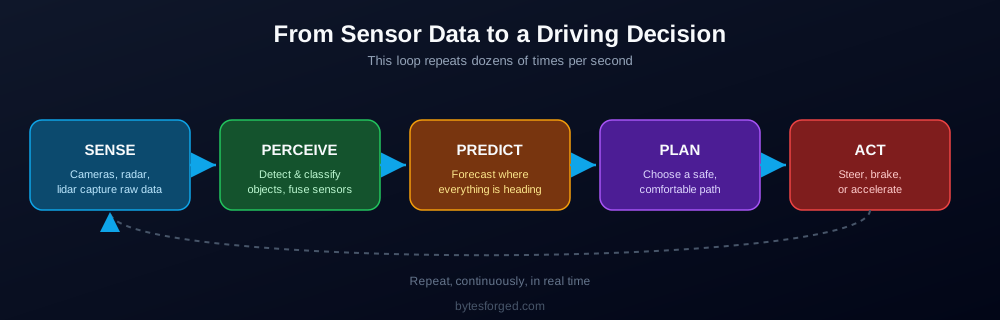
Self-driving cars don’t have eyes. They don’t even “see” the way you do. Instead, they build a live, constantly-updating model of the world from a handful of sensors, then hand that model to software that decides what to do next.
Here’s exactly how that works, broken into plain-English steps.
1. Cameras Give Self-Driving Cars Color and Context
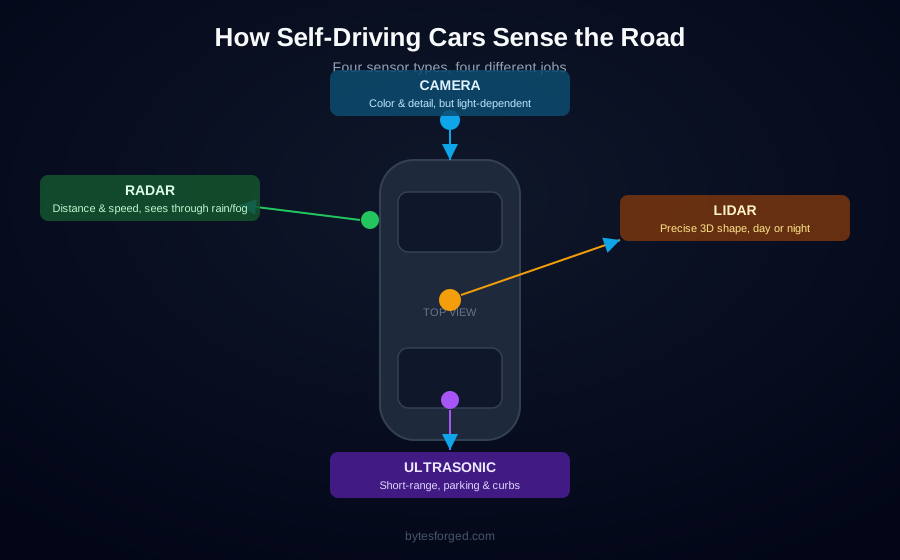
Cameras are the closest thing to human vision. They read traffic lights, road signs, lane markings, and pedestrians in full color and detail. The catch: cameras are passive. They depend on light, so they struggle at night, in heavy glare, or when the lens gets dirty.
2. Radar Tells Self-Driving Cars How Fast Things Are Moving
Radar bounces radio waves off nearby objects and measures the return signal to judge distance and speed — the same principle behind a police speed gun. It’s not great at identifying what an object is, but it barely notices rain, fog, or dust.
3. Lidar Builds a Precise 3D Map
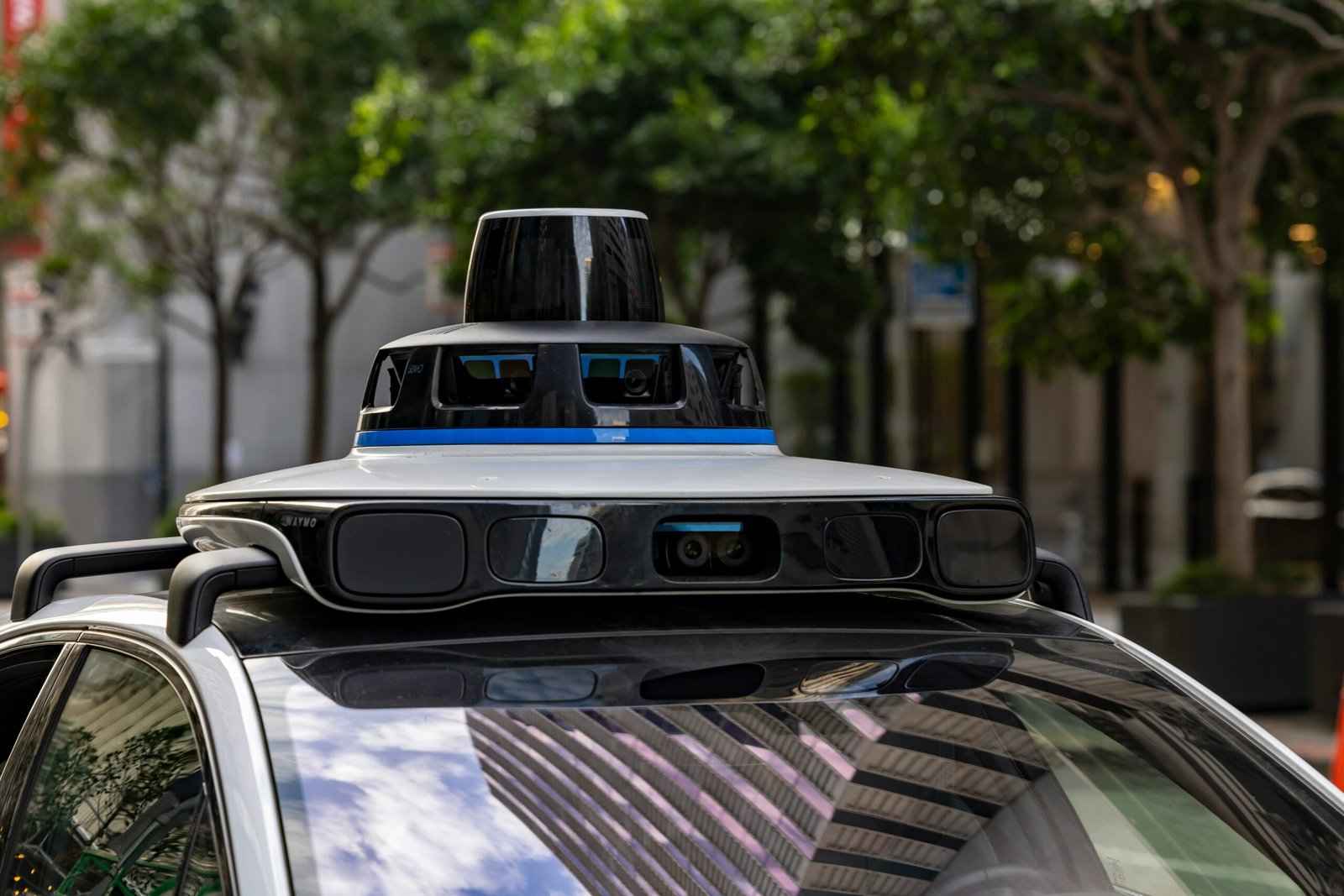
Lidar fires rapid pulses of laser light and times how long they take to bounce back, creating a detailed 3D “point cloud” of everything nearby — down to the exact shape of a curb or a cyclist. Because it generates its own light, it works equally well day or night. It’s also the most expensive piece of hardware in the stack, which is why not every company uses it.
4. Ultrasonic Sensors Handle Close-Range Jobs
Short-range sound-wave sensors handle low-speed tasks like parking and detecting a curb a few feet away.
5. Not Every Self-Driving Car Uses the Same Setup
The industry has split into two camps. Tesla uses a camera-only system, betting that cameras plus a powerful enough neural network can match human-level driving without extra hardware. Waymo instead fuses cameras, radar, and lidar together, arguing that no single sensor should be a single point of failure — if one struggles (say, a camera blinded by sun glare), the others cover the gap. Both companies lean heavily on machine learning; they simply disagree about how much of the world should be measured directly versus inferred from vision alone.
6. Self-Driving Cars Predict What Happens Next
Knowing where everything is right now isn’t enough. The car also has to guess where everything is about to be — will that pedestrian step off the curb, will that merging car actually complete the merge? Prediction models, trained on huge amounts of real driving data, forecast likely movements a few seconds ahead and update that forecast constantly as new data comes in.
7. Where Self-Driving Cars Still Struggle to See
Heavy rain, thick fog, and dust storms can significantly degrade camera performance — one reason some robotaxi services pause in bad weather. Rare, unusual objects (a mattress in the road, a person in a wheelchair moving unpredictably) are also hard, since no training dataset covers every possible scene. This is exactly why the sensor debate above hasn’t been settled — and why regulators like NHTSA continue to track how these systems perform before allowing wider rollout.
The Bottom Line
A self-driving car doesn’t see the road so much as reconstruct it — piecing together color, distance, speed, and shape from several different sensors, then predicting and planning on top of that model, dozens of times per second. Whether the winning formula ends up being cameras alone or a full sensor-fusion stack is still being decided on the road, in real time.