

Table of Contents
Quick answer
Here’s what offside in football actually is, in one sentence: an attacking player is offside if, at the moment a teammate plays the ball, any part of their head, body, or feet is in the opponents’ half and closer to the opponents’ goal line than both the ball and the second-last defender — though being in that position only becomes a punishable offense if the player then gets involved in play. Since 2022, that judgment has increasingly been supported by semi-automated offside technology (SAOT), which uses tracking cameras and a sensor inside the ball to flag close calls in seconds rather than minutes.
Key takeaways
- A player is in an offside position if any part of their head, body, or feet is nearer to the opponents’ goal line than both the ball and the second-last opponent — but arms and hands don’t count at all, for anyone, including the goalkeeper.
- Being in an offside position isn’t automatically an offense; a player is only penalized once they interfere with play, interfere with an opponent, or gain an advantage from that position.
- Semi-automated offside technology combines 12 tracking cameras (following 29 points per player, 50 times a second) with a sensor inside the match ball (recording 500 times a second) to pinpoint the exact moment the ball was played.
- The system generates an automated alert for human video officials to review — it doesn’t make the final call on its own, and a referee still has to act on it.
- For the 2026 World Cup, FIFA narrowed the threshold for automatic flag alerts from 50cm to just 10cm and started sending real-time audio alerts directly to assistant referees, cutting review time significantly compared to the system’s 2022 debut.
What is offside in football?
The offside position, under the actual rule
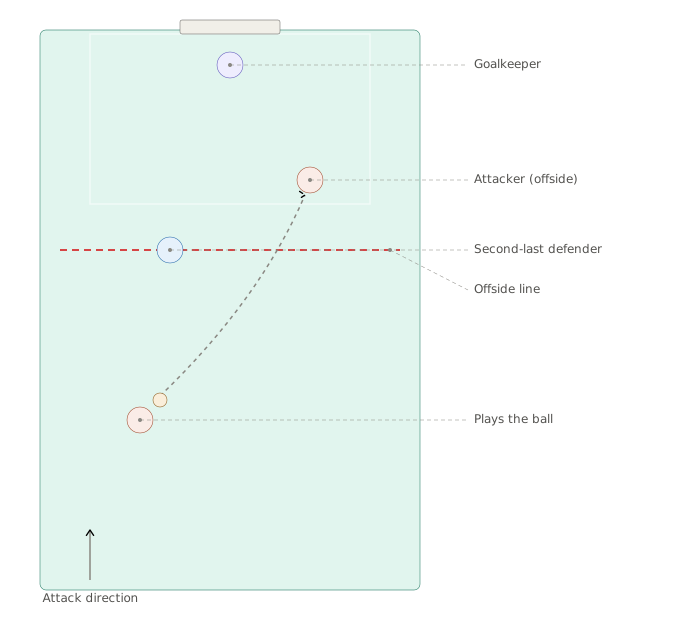
Offside is governed by Law 11 of the Laws of the Game, maintained by IFAB, the International Football Association Board. According to the official wording, a player is in an offside position if any part of their head, body, or feet is in the opponents’ half of the pitch (not counting the halfway line itself), and any part of their head, body, or feet is nearer to the opponents’ goal line than both the ball and the second-last opponent. Hands and arms are excluded entirely from this calculation for every player, including goalkeepers — officially, the cutoff point is the bottom of the armpit, which is why a shoulder can be judged offside while an outstretched arm cannot.
A player is not in an offside position if they’re level with the second-last opponent, or level with the last two opponents combined.
When offside actually becomes an offense
This is the part that trips up a lot of newer fans: simply standing in an offside position isn’t against the rules. A player is only penalized for an offside offense once they become involved in active play, which Law 11 defines as one of three things — interfering with play by touching a ball passed by a teammate, interfering with an opponent (for example, by blocking their line of sight), or gaining an advantage from the position, such as receiving the ball after it rebounds off a post, crossbar, or opponent.
Common exceptions people get wrong
A few situations are frequently misunderstood: a player cannot be called offside directly from a goal kick, a throw-in, or a corner kick, regardless of their position on the pitch. It’s also worth knowing that a player in an offside position who receives the ball from an opponent who deliberately played it — including via a deliberate handball — generally isn’t considered to have gained an advantage from the offside position.
How offside is officiated: from a linesman’s eye to VAR
For most of football’s history, offside was judged entirely by an assistant referee running the touchline, watching player positions and the moment the ball was played in real time, with no video assistance at all. That’s an extraordinarily difficult job to do with total precision — the relevant instant can last a fraction of a second, and the human eye simply isn’t built to freeze that moment perfectly, especially from an angle running parallel to the pitch rather than directly in line with the players involved.
The Video Assistant Referee (VAR) system, introduced widely from 2018 onward, added the ability to review close offside calls on video after the fact, with an official manually drawing lines across the pitch and picking the exact frame the ball was played. This was a meaningful improvement in accuracy, but it was also slow — reviews for genuinely marginal offside calls could take well over a minute, which is part of what pushed FIFA toward automating more of the process.
What is semi-automated offside technology (SAOT)?
Semi-automated offside technology is the system that automates the data-gathering and initial judgment behind an offside decision, first used at the 2022 World Cup in Qatar and expanded since.
The cameras and sensors behind it
The setup relies on two main data sources working together. Twelve dedicated tracking cameras, mounted underneath a stadium’s roof, follow the ball and track up to 29 separate points on each player’s body — head, shoulders, elbows, wrists, hips, knees, ankles, and feet — fifty times every second. At the same time, an inertial measurement unit sensor built into the match ball itself sends positional data 500 times per second, allowing the system to pinpoint the exact instant the ball is kicked with far more precision than a human reviewing a video frame by frame.
How a SAOT decision actually happens, step by step
When the ball is played to a potentially offside attacker, the system combines the ball-tracking data with the limb-tracking data to automatically generate an offside alert. That alert goes to human video match officials first, not directly to the referee — they check the system’s recommendation against the footage before passing a confirmed decision on to the referee on the pitch. Only after the referee’s decision is confirmed does the broadcast typically show the now-familiar 3D animation, reconstructing exactly where each relevant player and the ball were at the key moment.
What’s changed for the 2026 World Cup
For the 2026 tournament, FIFA refined the system in a couple of meaningful ways. Automated alerts are now sent as real-time audio directly into assistant referees’ earpieces, rather than being routed through the video review booth first, which lets the on-field officials raise a flag immediately for clear-cut cases. FIFA also narrowed the margin required to trigger that automatic alert from 50 centimeters in earlier trials down to just 10 centimeters, aiming to only auto-flag the plays where the system’s confidence is very high, while still sending closer calls through full video review.
Does the technology replace the referee?
No — and this is worth being clear about, since it’s a common misconception. Semi-automated offside technology is explicitly designed to assist human officials, not replace their judgment. The system generates a data-backed recommendation; a human video official verifies it, and the on-field referee makes the final call. It’s also worth noting that some parts of the process still involve human input behind the scenes — for genuinely ambiguous body positions, officials can still manually select the moment the ball was played and adjust reference lines themselves, meaning “semi-automated” is an accurate description, not a marketing exaggeration.
Frequently asked questions
Is offside technology 100% accurate? It’s far more precise than a human eye alone, since it captures player and ball positions at a much higher frequency than video review previously allowed, but it still depends on camera calibration and human verification at key steps, so it isn’t infallible — it’s a significant improvement in precision, not an absolute guarantee.
Why do the offside lines on TV sometimes look like they contradict what fans see live? The broadcast graphic reflects a very specific, narrow moment — the exact instant the ball left the passer’s foot — captured from data most viewers can’t perceive in real time watching from a wide camera angle, which is part of why decisions that look wrong at full speed often look clearly correct once the 3D reconstruction is shown.
Does every professional league use semi-automated offside technology? No. It debuted at the men’s 2022 World Cup and has since been adopted by a number of major competitions and leagues, but adoption varies significantly by competition and country, largely due to the cost of installing the required camera and sensor infrastructure in every stadium.
If a player is in an offside position but never touches the ball, are they penalized? Generally no — under Law 11, being in an offside position only becomes an offense if the player interferes with play, interferes with an opponent, or gains an advantage from the position, so a player who is offside but stays out of the action typically isn’t penalized.
The bottom line
Offside has always been one of football’s trickiest laws to apply consistently, because it depends on judging an exact instant in a fast-moving game from an imperfect vantage point. Semi-automated offside technology doesn’t remove that difficulty entirely, but it replaces guesswork with genuinely precise data — a ball sensor recording 500 times a second and cameras tracking 29 points per player, 50 times a second — while still leaving the actual decision in human hands. As the technology gets faster and more tightly integrated with on-field officials, as it has for the 2026 World Cup, the goal isn’t to take the referee out of the loop; it’s to make sure they’re working from the clearest possible picture when a call has to be made in seconds.
Sources: IFAB — Law 11: Offside, Origami — VAR and Semi-Automated Offside Technology at the World Cup 2026, Bolavip — How VAR and SAOT will work at the 2026 World Cup.