
Table of Contents
Quick answer
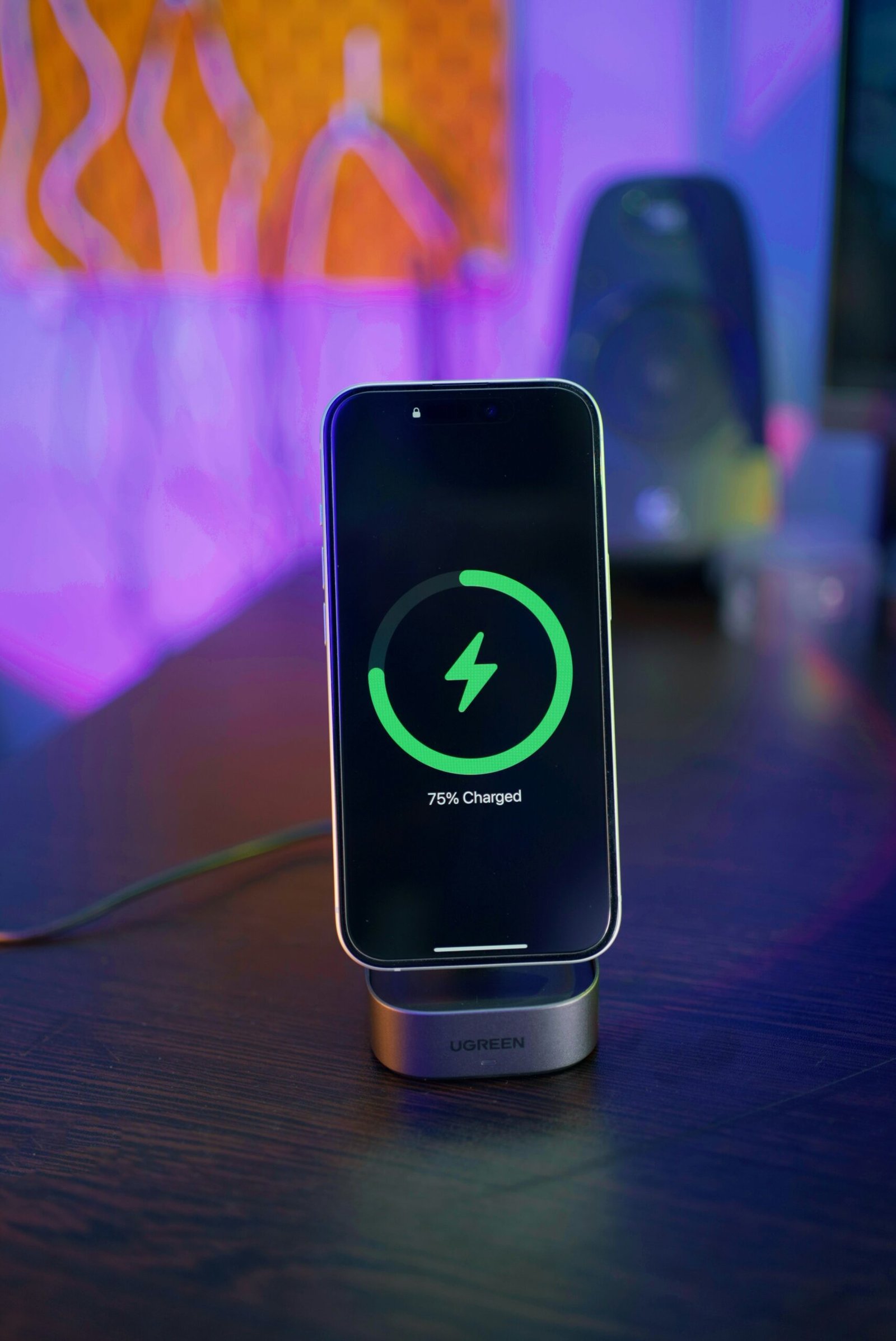
Here’s how wireless charging works, in one sentence: a coil inside the charging pad generates a magnetic field, and a matching coil inside your phone converts that field back into electrical current to charge the battery — no physical contact needed, just close proximity between the two coils.
Key takeaways
- Wireless charging runs on electromagnetic induction, the same basic physics used in transformers, generated between a transmitter coil in the pad and a receiver coil in the device.
- Qi, developed by the Wireless Power Consortium (WPC), is the near-universal wireless charging standard — more than 13,000 Qi Certified products are on the market today.
- Qi2, introduced in 2023, added a Magnetic Power Profile (MagSafe-style built-in magnets) that keeps the phone perfectly aligned with the coil, which is what actually unlocked faster, more efficient charging.
- The newest tier, Qi2 25W, launched in July 2025 and delivers roughly 70% more power than the original Qi2 — some chargers can take a phone from 0% to 50% in about 30 minutes.
- Wireless charging is still slower than top wired speeds (USB-C Power Delivery can exceed 65W), but it’s expanding well beyond phones, into cars, AR/VR headsets, and magnetically attached battery accessories.
What is wireless charging?
Wireless charging is a way of transferring electrical power to a device without a physical cable connection. Despite the name, it isn’t actually wireless over any real distance — it works over a gap of just a few millimeters, with the device essentially resting directly on or very near the charger. It’s less “charging through the air” and more “charging through contact, without a plug.”
How wireless charging actually works
Electromagnetic induction: the physics behind the pad
A wireless charger contains a coil of wire, called the transmitter coil, connected to a power source. When electricity flows through it, that coil generates an oscillating magnetic field. Your phone contains a second coil, the receiver coil, positioned to sit directly opposite the transmitter’s when you place the phone on the pad. That magnetic field induces an electrical current in the receiver coil, which gets converted into direct current and used to charge the battery.
If this sounds familiar, it’s because it’s the same underlying principle behind how NFC chips work — two coils, one shared electromagnetic field. The difference is scale and purpose: wireless charging moves enough energy to gradually fill a battery over time, while NFC uses a much weaker field just to briefly power a tiny chip and exchange a small amount of data.
Why alignment used to be the biggest problem
For years, the biggest practical flaw in wireless charging was alignment. The transmitter and receiver coils need to sit closely opposite each other to transfer power efficiently, and even a small offset could slow charging noticeably or stop it altogether. This is why early wireless chargers often felt finicky — set your phone down slightly off-center, and it might not charge at all until you nudged it into place.
Qi2 and the Magnetic Power Profile
Qi2, the current generation of the Qi standard released by the WPC in 2023, solved the alignment problem by building magnets directly into the standard — a system called the Magnetic Power Profile (MPP). Instead of relying on the user to eyeball correct placement, the phone and charger snap together magnetically in the one position that lines the coils up perfectly every time.
That alignment isn’t just about convenience — it’s the actual reason Qi2 charges faster and more efficiently than earlier Qi versions. Precise coil alignment reduces energy loss during transfer, so more of the power reaching the pad actually makes it into the battery. According to the WPC, every product officially branded with the Qi2 logo is required to include this magnetic alignment system; phones without built-in magnets can still access the same benefits through a certified magnetic case, under a separate “Qi2 Ready” designation.
Where you’ll find wireless charging today
Smartphones
Qi2 launched in 2023 at up to 15W. Qi2 25W, a newer tier of the same standard, launched in July 2025 and offers close to 70% more charging power — fast enough that, according to the WPC, some certified Qi2 25W chargers can take a phone from empty to 50% in around 30 minutes, putting it in the same range as many wired chargers. Devices like the iPhone 12 and newer, along with the Pixel 10, have the required magnets built in, while phones such as the Galaxy S25 are “Qi2 Ready,” meaning they need a magnetic case to get the same alignment benefits.
MagSafe vs. Qi2
Apple’s MagSafe predates Qi2 and uses a similar concept: magnets built into the phone and charger for automatic alignment. Qi2’s Magnetic Power Profile was developed in collaboration with Apple and is built on the same underlying idea, which is why MagSafe accessories and Qi2 chargers are largely interoperable today, rather than being two competing, incompatible ecosystems.
Beyond phones
Wireless charging has expanded past smartphones into wearables, earbud cases, and increasingly, vehicles — several 2026 electric vehicle models now integrate Qi charging pads directly into their center consoles. The WPC has also highlighted that Qi2’s magnetic locking system opens the door to new product categories, including AR/VR headsets and magnetically attached battery packs that clip onto the back of a phone.
Wireless vs. wired charging: what’s the real difference
| Wired (USB-C Power Delivery) | Wireless (Qi2 25W) | |
|---|---|---|
| Typical top speed | Can exceed 65W | Up to 25W |
| Alignment required | No | Yes, though magnets now handle it automatically |
| Cable wear over time | Yes — connectors and cables degrade with use | None |
| Best suited for | Fastest possible top-ups | Convenient, low-effort daily charging |
Is wireless charging safe for your battery?
This is one of the most common concerns, and it’s a reasonable one. The WPC has stated that Qi2 was specifically designed to deliver faster charging without shortening battery life or damaging the device’s internal components, and Qi Certified products go through independent lab testing for safety and interoperability before they’re allowed to carry the Qi or Qi2 logo. In practice, modern phones also manage their own charging temperature automatically, tapering the charge rate if a device gets too warm, regardless of whether the power is coming through a cable or a coil.
Frequently asked questions
Does wireless charging damage my phone’s battery over time? Not inherently. Modern phones regulate charging temperature and rate automatically, and the WPC’s Qi2 standard was specifically designed not to shorten battery life compared to wired charging.
Can I use any phone case with a wireless charger? Generally yes, as long as the case isn’t made of metal and stays under roughly 3–5mm thick, both of which can interfere with the magnetic field or physically increase the gap between coils.
Is wireless charging as fast as plugging in? Not quite, in most cases. Wired USB-C Power Delivery can exceed 65W, while even the newest Qi2 25W tier tops out at 25W — though Qi2 25W is fast enough to noticeably close that gap for everyday charging.
What does “Qi2 Ready” mean, versus just “Qi2”? “Qi2” means a device has the required magnets built in. “Qi2 Ready” means the device supports the same charging speeds and standard but needs a certified magnetic case to get the alignment benefits, since it doesn’t have magnets built into the phone itself.
The bottom line
Wireless charging comes down to two coils and a shared magnetic field — one turns electricity into a field, the other turns that field back into electricity. What’s changed over the past few years isn’t the core physics, it’s the alignment: Qi2’s built-in magnets turned “close enough” placement into “exactly right, every time,” and that precision is what’s made modern wireless charging fast enough to start rivaling a cable. With the WPC continuing to push speeds higher and expanding the standard into cars, wearables, and headsets, the plug may end up being the exception rather than the rule.
Source: Wireless Power Consortium — Qi wireless charging standards and knowledge base.