
Power Bank Efficiency vs. Battery Capacity: Which Actually Matters More?
Every power bank listing leads with one number: mAh. 10,000. 20,000. 30,000. It’s the first thing you compare, and it’s also the number that lies to you the most. Power bank efficiency — not the capacity printed on the box — is usually what decides how many times you actually charge your phone before the bank goes flat, and almost nobody puts that number on the packaging.
This isn’t a “bigger is always better” or “efficiency is all that matters” piece. It’s the actual math behind both, so you can tell which one your next purchase should prioritize.
[IMAGE: hero graphic comparing a power bank’s rated mAh vs. its usable mAh — alt text: “power bank efficiency vs mAh capacity comparison”]
Quick answer: Power bank efficiency determines what percentage of the printed mAh figure you actually receive — typically 70–90%. Battery capacity determines the total energy on hand before that loss. For daily phone charging, prioritize efficiency; for multi-day or high-drain use, prioritize capacity. Read on for the math behind both.
What Power Bank Capacity (mAh) Actually Measures
The mAh rating on a power bank describes the capacity of the raw lithium-ion or lithium-polymer cells inside it, measured at their internal voltage — almost always 3.6–3.7V. That number has nothing to do with what comes out of the USB port.
Your phone, laptop, or earbuds case doesn’t charge at 3.7V. USB output is 5V by default, and fast-charging protocols push it to 9V, 12V, 15V, or 20V depending on the device. To bridge that gap, every power bank runs its stored energy through a boost converter that steps the voltage up before it reaches the cable. That conversion is not free, and the mAh figure on the box never accounts for the cost.
So when a brand advertises “20,000mAh,” it’s telling you what the cells hold, not what your phone will receive. That gap between the printed number and the delivered number is exactly what power bank efficiency measures.
This is also why watt-hours (Wh) is a more honest spec than mAh alone. Wh accounts for voltage, so it describes actual stored energy rather than just a charge count at an unspecified voltage. Two power banks can share the same mAh rating and still hold meaningfully different amounts of real energy if their internal cell voltages differ — one more reason the box number alone can’t tell you how a bank will actually perform.
Power Bank Efficiency Explained: Where the Missing mAh Goes
Power bank efficiency is the percentage of the internal battery’s stored energy that actually reaches your device as usable charge. In practice, most consumer power banks land somewhere between 70% and 90% efficiency, and three things eat up the rest.
Voltage Conversion Loss
Stepping 3.7V up to 5V (or higher, for USB-PD) happens inside a DC-DC boost converter. Even a well-designed one only operates at 85–92% efficiency depending on load, and cheaper circuits do worse. This single step is usually the biggest source of loss in the whole system.
Internal Resistance and Heat
Lithium cells and the circuitry around them have internal resistance, which causes voltage sag under load and bleeds energy off as heat. This is why a power bank gets warm while charging something quickly — that warmth is capacity you paid for and didn’t get.
Standby and Circuit Overhead
A power bank isn’t just a battery; it’s a battery plus a battery-management chip, LED indicators, and (on multi-port units) additional switching circuitry. All of that draws a small continuous current just to keep the system running, even before any energy reaches your cable.
Stack those three losses together and it’s easy to see why a “20,000mAh” bank rarely delivers anywhere near 20,000mAh to your phone.
Why No Power Bank Can Ever Hit 100% Efficiency
It’s worth being clear that this isn’t a manufacturing shortcut brands could fix with better parts — it’s physics. Every energy conversion loses some energy as heat; that’s the second law of thermodynamics, and it applies to a $5 power bank exactly as much as it applies to a power station. There’s no version of a boost converter, however well engineered, that turns 100% of its input into output.
Three physical limits guarantee that:
- No real conductor has zero resistance. Wires, traces, and connectors all resist current flow to some degree, and that resistance always bleeds off a little energy as heat the moment current moves through them.
- Switching transistors aren’t perfect switches. The transistors inside a boost converter have to switch on and off tens of thousands of times per second, and each switch — even in the best silicon or GaN designs — dissipates a small amount of energy rather than passing all of it through.
- Batteries themselves aren’t perfectly efficient. Charging and discharging a lithium-ion cell involves chemical reactions that don’t run at 100% coulombic efficiency; some of the energy that goes in during charging never comes back out during discharge, even before it reaches the boost converter.
That’s why even the best GaN-based, PD-certified power banks on the market top out around 90–95% efficiency in the conversion stage alone, and end-to-end efficiency — cell to cable — lands lower once every stage is counted. A power bank efficiency rating in the high 80s to low 90s isn’t a poorly engineered product; for the physics involved, that’s close to the ceiling.
The Real Math: How Much Charge You Actually Get
Here’s the formula worth remembering:
Usable Capacity = Rated Capacity × Power Bank Efficiency
A power bank with a published efficiency of 80% and a 10,000mAh rating delivers roughly 8,000mAh of real, usable charge. Most brands don’t publish an efficiency number at all, which is exactly why the mAh figure alone is such an unreliable way to shop.
Independent testing on a mainstream 10,000mAh bank found it delivering closer to 62% of its rated capacity once voltage conversion, internal load, and the bank’s own power draw were accounted for — around 6,000–6,500mAh usable, not 10,000. That’s not a defective unit; it’s a fairly typical result for a budget boost converter. Protocol-analyzed teardown data shows the same pattern across most consumer power banks, with roughly 30% of rated capacity lost to voltage conversion and internal resistance before it ever reaches a device.
Efficiency vs. Capacity: Which One Actually Matters More?
Neither wins outright — they answer different questions, and the right one depends on what you’re optimizing for.
When a Bigger Battery Wins
If you need to charge a laptop, a camera, or multiple devices over several days off-grid — camping, travel, field work — raw capacity matters more than squeezing out the last few percentage points of efficiency. A larger, moderately efficient bank will still out-deliver a smaller, highly efficient one in total usable energy, simply because it started with more to lose.
When Power Bank Efficiency Wins
If you’re comparing two banks of similar size — say, two 10,000mAh units — efficiency is the entire story. It’s the difference between a compact bank that reliably gives you 2.5 phone charges and one that gives you 1.8, despite an identical number on the box. Efficiency is also what determines value per gram and value per dollar, which matters most for daily-carry use where you’re optimizing for pocket space, not maximum runtime.
How to Tell If a Power Bank Is Actually Efficient
Manufacturers rarely print an efficiency percentage, so you have to read around it:
- Look for Wh, not just mAh. A spec sheet that lists watt-hours alongside mAh signals a brand that’s being more transparent about real energy content.
- Favor USB-PD and Quality Charging (QC) certified units. Certified fast-charging protocols generally run through better-engineered, more efficient conversion circuitry than generic “fast charge” claims.
- Check for GaN-based charging circuitry. Gallium nitride components run cooler and convert power more efficiently than older silicon-based designs, especially at higher wattages.
- Read third-party teardown or bench-test reviews, not just marketing copy — outlets that actually measure output-to-input ratios will tell you more than any spec sheet.
- Be suspicious of unusually low prices on unusually high capacities. A 30,000mAh bank priced like a 10,000mAh one has almost certainly cut corners in the conversion circuitry to hit that capacity number cheaply.
- Check how many ports are active at once. Banks that maintain their rated output across multiple simultaneous ports without a steep voltage drop are generally running a more capable — and more efficient — internal design than ones that throttle hard the moment a second device is plugged in.
None of these signals guarantee a specific efficiency percentage on their own, but stacked together they’re a far better predictor of real-world performance than the mAh number by itself.
Real-World Example: Comparing Two 20,000mAh-Class Power Banks
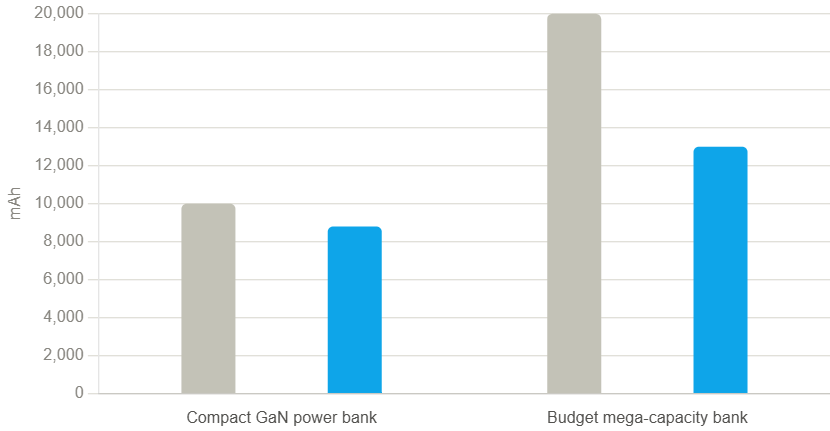
To see how much power bank efficiency changes the outcome even when capacity is identical on paper, here’s a realistic comparison based on typical efficiency ranges for budget vs. well-engineered units:
| Compact GaN Power Bank | Budget “Mega-Capacity” Bank | |
|---|---|---|
| Rated Capacity | 10,000mAh | 20,000mAh |
| Typical Efficiency | ~88% | ~65% |
| Usable Capacity | ~8,800mAh | ~13,000mAh |
| iPhone 15 Charges (3,349mAh battery) | ~2.6 | ~3.9 |
| Weight | ~190g | ~420g |
The bigger bank still wins on total charges — that’s simple physics, it started with twice the energy. But notice the ratio: it’s carrying more than double the weight to deliver only about 1.5x the real-world charges, because a third of its rated capacity never makes it out of the boost converter. That’s the cost of low power bank efficiency, and it’s invisible until you do the math yourself.
The Hidden Costs of Chasing Bigger Capacity
Bigger numbers on the box come with trade-offs that rarely make it into a product listing:
- Weight and bulk. Battery capacity scales roughly linearly with weight — there’s no way around the physics, so “bigger” always means “heavier.”
- Charging time. A larger, less efficient bank doesn’t just take longer to charge — some of the energy you put in to fill it is lost the same way it’s lost coming back out.
- Airline limits. In the US, the TSA requires spare lithium-ion batteries — including power banks — to travel in carry-on baggage only, and caps them at 100 watt-hours per battery without special airline approval. At a typical 3.7V nominal cell voltage, that ceiling works out to roughly 27,000mAh — a limit that has nothing to do with efficiency and everything to do with the raw cell size you’re chasing.
- Diminishing real-world returns. Past a certain point, extra rated capacity mostly compensates for losses you could have avoided by buying a more efficient bank in the first place.
So, Should You Buy for Efficiency or Capacity?
A simple way to decide:
- Buy for capacity if you need multi-day, off-grid runtime or you’re regularly charging power-hungry devices like laptops and tablets, and you’re willing to carry the extra weight.
- Buy for power bank efficiency if you’re charging phones, earbuds, or small devices daily and care about pocket size, weight, and getting the most out of every mAh you’re paying for.
- Ignore the mAh number in isolation either way. Cross-reference it against a published Wh figure, a PD/QC certification, or an independent bench test before trusting the box.
Conclusion
The mAh number on a power bank box tells you what’s stored, not what you’ll get. Power bank efficiency — the percentage that actually survives voltage conversion, internal resistance, and circuit overhead — is what determines real-world performance, and it’s rarely printed anywhere. For occasional, high-volume charging, capacity still wins outright. For everyday carry, efficiency is where the real value is hiding.
Also read: How self driving cars see the road