
By AISEN · Published August 24, 2026 · Updated November 22, 2026
Picture a rainy night. A cyclist with no lights is riding along the edge of the road, sixty meters ahead. You’d probably notice them late, if at all. A self-driving car has several separate ways to notice that cyclist, and none of them is a pair of eyes.
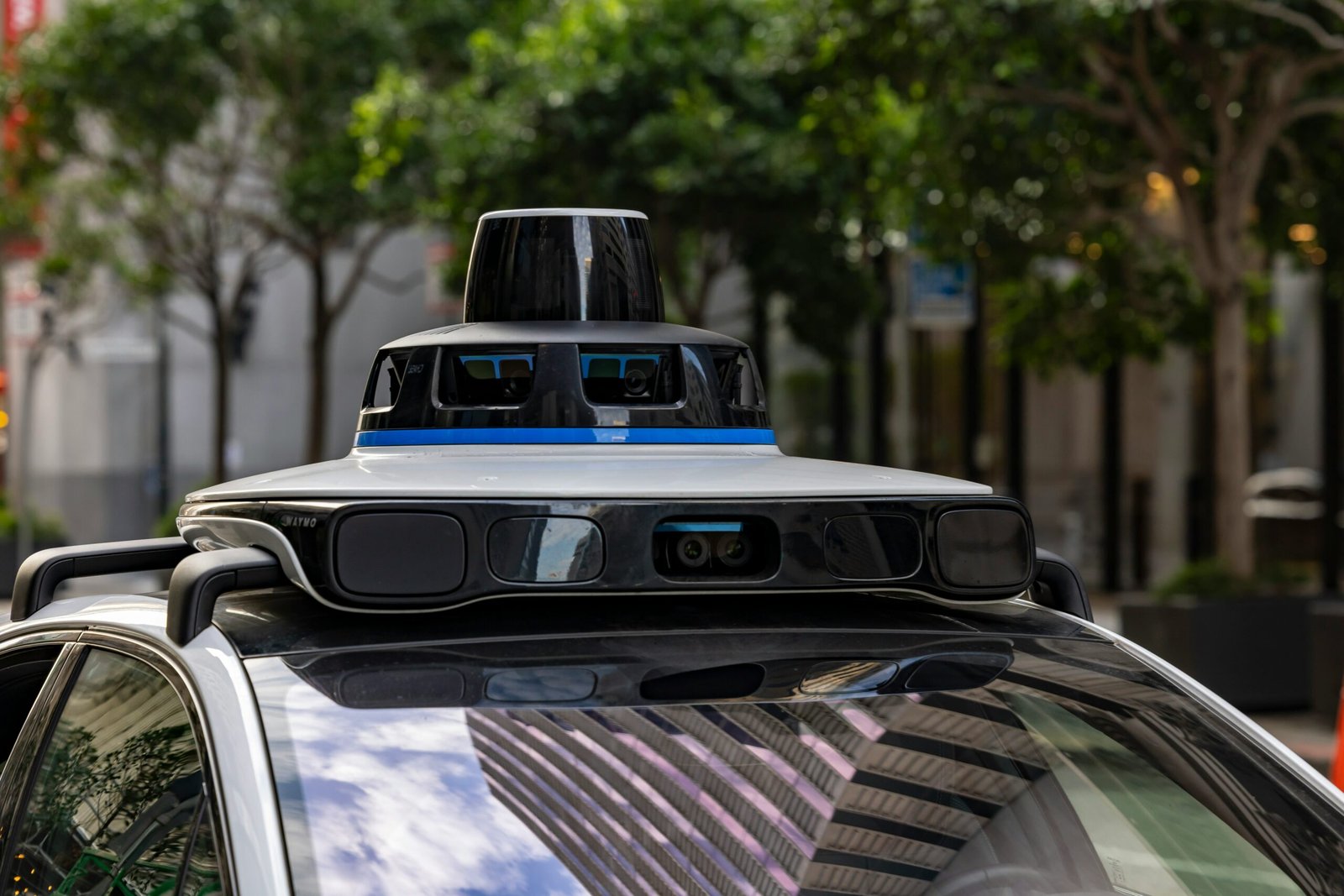
That’s the heart of how self-driving cars see the road. They don’t rely on one clever sensor. They combine cameras, radar and, on many vehicles, lidar, then use maps and software to decide what all that data means. Each sensor is good at something the others are bad at, which is the whole reason for carrying more than one.
Table of Contents
How self-driving cars see the road: four sensors, four different strengths
| Sensor | How it works | Good at | Weak at |
|---|---|---|---|
| Cameras | Record video; software identifies objects, lane lines, signs and lights | Color and detail, such as reading a sign or telling a red light from a green one | Glare, darkness, fog and dirt, and distance has to be estimated, not timed |
| Radar | Sends radio waves and measures the reflections | Distance and how fast something is closing, and it often keeps working in rain, fog and darkness | A coarse picture, so it’s harder to tell what an object is |
| Lidar | Fires laser pulses and times how long each takes to return | Precise 3D shape and distance, day or night | Heavy rain, snow or fog can scatter the light, and it sees no color |
| Ultrasonic | Sends out sound pulses and listens for echoes | Very short range, such as parking | Only works a few meters out |
Cameras are the closest thing to human eyes. They’re the only sensor that can read a stop sign or notice that brake lights have come on, which is why even cars full of other sensors carry plenty of them. Waymo’s sixth-generation system, for example, has 13. Their weakness is the same as ours: they need light, and glare, fog and a dirty lens can blind them. Unlike lidar and radar, a conventional camera doesn’t time a reflected signal to measure distance. The software estimates how far away things are from visual cues, motion and, in some systems, views from several cameras.
Radar works like the speed gun a police officer points at traffic. It sends out radio waves and listens for the reflections, and if the object is moving, the returning waves change frequency slightly. That is the Doppler effect, and it lets radar estimate how quickly an object is moving toward or away from the car. Tracking an object across many measurements fills in the rest of its movement. Radio waves handle rain, fog and snow better than light does, so radar often keeps working when cameras and lidar struggle, though it isn’t immune to every condition. The trade-off is detail. Traditional radar sees a blob, not a cyclist, although newer imaging radar, which Waymo says it uses, sharpens the picture.
Lidar is the one most people have heard about. A lidar unit sends out rapid pulses of laser light across its field of view and times how long each one takes to bounce back. Several units placed around a car can combine their readings into a wider, sometimes 360-degree, view. Light travels about 300,000 kilometers per second, so the timing gives distance with simple arithmetic. If a pulse returns after 400 billionths of a second, it hit something 60 meters away: 300,000,000 meters per second, times 0.0000004 seconds, divided by two because the light made a round trip. Plot every return as a dot and you get a 3D “point cloud” of the surroundings. Lidar brings its own light, so night makes no difference to it, although heavy rain, snow or fog can scatter the beam and reduce its range.
Ultrasonic sensors use sound, like a bat, but only over a few meters. They’re mostly for parking and creeping in tight spaces. Some systems add microphones as well. Waymo’s sixth-generation Driver includes external audio receivers, which help it hear things like emergency vehicle sirens.
Now back to the unlit cyclist. A camera may struggle to pick them out in rain and darkness. Radar will notice a moving object and its speed but not exactly what it is. Lidar will draw its outline. None of the three gives the full answer, and together they usually do. That combination has a name, and it’s coming up.
Knowing where it is: maps, GPS and a sense of motion
Seeing the road isn’t enough. The car also has to know exactly where it is on it, to within a lane, and the GPS in your phone isn’t precise enough for that. It’s often accurate to a few meters at best, and worse between tall buildings. So self-driving systems don’t rely on satellites alone. They combine satellite positioning (GNSS) with inertial sensors that track acceleration and turning between fixes, wheel-speed measurements and a highly detailed map. The software can then compare landmarks that cameras and lidar detect with what’s stored in the map, and use any mismatch to correct its position.
Waymo says its system pairs detailed custom maps with live sensor data to work out its precise position at all times. The idea is simple: the map says what the road should look like, the sensors show what it looks like right now, and where the two match is where the car must be. Tesla takes a different approach, covered below, built mainly on cameras.
Sensor fusion: one picture from many sources
Each sensor reports its own version of the scene. The software has to decide that a radar blob moving at cycling speed, a lidar shape about the size of a bicycle and a camera’s “cyclist” label are all the same thing. That step is called sensor fusion, and it’s more than averaging. The car trusts different sensors in different conditions, can lean on radar in fog, for example, and flags the situation if sensors disagree.
It’s also where redundancy comes from. Waymo describes its camera, lidar and radar as giving complementary, overlapping views, so if one is degraded, the others still cover the same ground.
Seeing is the easy part: predict, plan, act
Once the car has a picture, it has three more jobs, and they repeat many times every second:
- Predict. Where will the pedestrian go next? Will that car merge? The software estimates likely paths for everything nearby.
- Plan. Given those predictions, it picks a path and speed that stay safe, follow the rules and don’t feel like a roller coaster.
- Act. It turns the plan into steering, braking and acceleration commands.
The same perceive-decide-act loop drives enemies in video games, which we described in how AI makes games better. The difference is that a game character’s mistake costs a life bar.
Speed matters here. As an illustration, a car at 50 km/h covers about 1.4 meters in a tenth of a second, and at 100 km/h about 2.8 meters. That’s why sensing, understanding and deciding have to happen fast, and why the computers in these cars are so powerful.
“Self-driving” means two different things
Two cars can both be called self-driving and be nothing alike. The standard way to tell them apart is the SAE’s six levels of driving automation, which NHTSA uses:
| Level | Who is driving? | Example |
|---|---|---|
| 0 | You, with no automation | Warnings only, such as blind-spot alerts |
| 1 | You, with help on either steering or speed | Adaptive cruise control |
| 2 | You, supervising combined steering and speed assistance | Highway lane-centering plus adaptive cruise |
| 3 | The system, in limited conditions, but you must take over when it asks | A traffic-jam feature |
| 4 | The system, within a defined area. No driver is needed | A driverless taxi service |
| 5 | The system, anywhere, in all conditions | Not commercially deployed |
The big jump is between 2 and 4. At Level 2, the human is responsible every second. At Level 4, within its zone, the human is a passenger.
That’s why the headlines about Waymo and Tesla describe such different things. Waymo’s robotaxis run without a safety driver in defined service areas, which is Level 4. Tesla’s consumer Full Self-Driving is still sold as “Supervised,” meaning the driver must pay attention, which is how standards bodies treat driver-supervised systems. When you read about a car “driving itself,” check which kind it is.
Two bets: many kinds of sensors, or mostly cameras
This is the most argued-over design choice in the field.
Waymo’s bet is more kinds of sensors. Its sixth-generation Driver has 13 cameras, 4 lidar units and 6 radar units, plus the audio receivers. That is reportedly about 42% fewer sensors than the previous generation. The sensors also have wipers to clear dirt and rain. In spring 2026, Waymo was reported to be providing roughly 500,000 paid rides a week across about 10 US cities, and it says its safety data covers about 220 million rider-only miles through March 2026.
Tesla’s bet is cameras first. Its FSD (Supervised) system relies primarily on camera-based visual perception rather than lidar and radar. The cars still carry other hardware, including GPS, inertial sensors and driver-monitoring systems, but the view of the road comes mainly from cameras and neural networks. Tesla’s argument is that humans drive with eyes and a brain, so a car with strong enough computer vision can too. Tesla began offering some Robotaxi rides in Austin without a safety monitor in the car on January 22, 2026. At first that was a small number of vehicles mixed in with others that still had safety monitors. Federal regulators are watching closely, and in early September NHTSA opened an audit query into Tesla’s certification that the Cybercab meets federal safety standards.
Which approach will win is still an open question. What you can say today is that the largest driverless service uses lidar. Safety comparisons between companies are also hard, because each counts and reports crashes differently, so look at the methodology before you trust any headline number.
Where they still struggle
Driverless doesn’t mean mistake-free, and Waymo, the industry’s most experienced operator, is under scrutiny too. In January 2026 the NTSB opened an investigation after a Waymo robotaxi passed a stopped school bus that was loading students in Austin, and its preliminary report came out in March. Reporting on that report says the car stopped, then asked a remote assistance agent about the bus’s signals and was told, incorrectly, that it wasn’t signaling. It’s a reminder that humans are part of these systems too.
The issue has stayed in the news. On November 6, 2026, NHTSA opened a recall query into whether Waymo’s 2025 software recall actually fixed the problem. The agency said a majority of the incidents it identified happened after Waymo reported completing the update on November 17, 2025, and that this calls into question the remedy’s effectiveness. A recall query examines whether a fix worked. It isn’t a finding that it failed, and Waymo says it has made significant improvements and hasn’t received a citation since March 2026.
The hard cases tend to be the rare ones. Unusual road layouts, construction zones and unclear hand signals appear less often in training data, so the software has fewer examples to learn from. Weather is another limit. Waymo says its latest Driver can run in snowier cities, which was a restriction before, but heavy snow, ice and dirt on sensors remain real challenges.
How to read a self-driving claim
A few questions cut through most of the hype:
- Does anyone have to supervise? If a driver must stay ready, it’s Level 2, however impressive the demo.
- Where and when does it work? Driverless services run inside mapped zones. A system that works “anywhere” would be a Level 5, which hasn’t been commercially deployed.
- What does it sense with? Mostly cameras, or cameras plus radar and lidar? More sensors mean more cross-checks, but also more cost.
- Who reports the safety data, and how? Look for the number of miles, the type of roads and how crashes are counted.
A self-driving car doesn’t so much see the road as reconstruct it, from light, radio waves, laser timing, maps and a great deal of software. Understanding what each part can and can’t do is the best defense against both the hype and the panic.
Updated [update date]: this post was rewritten and expanded with current details on Waymo and Tesla. I haven’t tested these vehicles myself. Figures come from the company announcements and reports linked in the text, and the services change quickly.