
Table of Contents
Augmented reality glasses look like ordinary eyewear, but somehow they can float a notification in your field of view, translate a menu in real time, or overlay a giant virtual screen onto thin air. It’s a strange bit of magic the first time you try it — so how do AR glasses display images without a regular screen sitting in front of your eyes?
The short answer: they don’t project light at a screen, they inject it directly into your eye using tiny optical engines and specially engineered lenses. The long answer involves waveguides, birdbath optics, motion sensors, and a surprising amount of computer vision happening in a frame that weighs less than 100 grams. Here’s how it all fits together.
What Is AR, Really?
Augmented reality overlays digital information — text, images, 3D objects — onto your view of the real world, in real time. That’s different from virtual reality, which replaces your surroundings entirely with a simulated environment. AR glasses are built around one core constraint that VR headsets don’t have to worry about: you still need to see through the lens. Whatever display technology is used has to stay mostly transparent while somehow also showing a bright, crisp image.
That single requirement is why AR glasses look so different on the inside from a phone or a TV, and why the display itself is the hardest engineering problem in the whole device.
How Do AR Glasses Display Images Without a Screen?
There’s no LCD or OLED panel floating in front of your eyeball. Instead, AR glasses use a small light engine tucked into the arm or brow of the frame, paired with an optical structure built into the lens that redirects that light into your eye. Three approaches dominate the market right now.
Waveguide displays
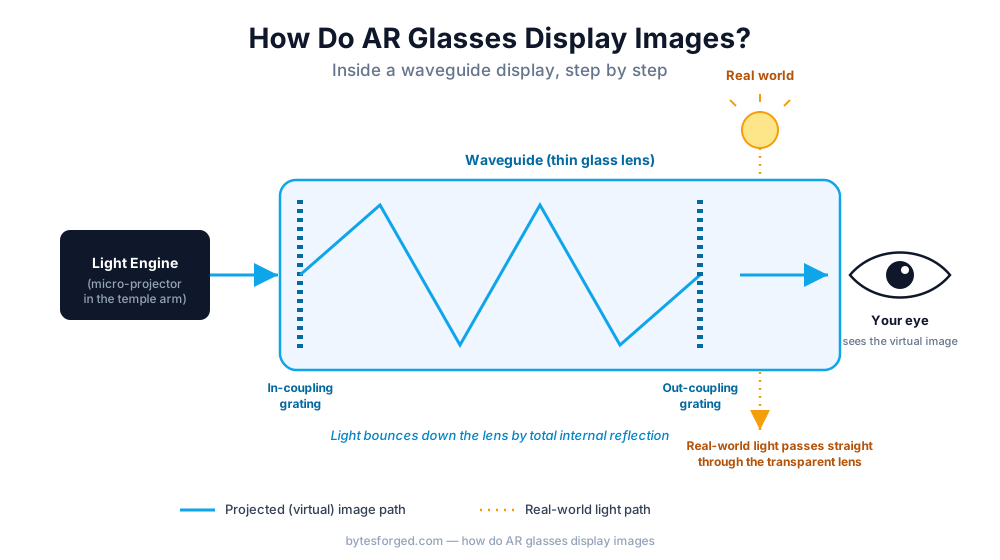
Waveguides are the technology used in most higher-end AR glasses and headsets, including devices from Microsoft, Magic Leap, and several of the newer consumer smart glasses. A micro-projector shines an image into the edge of a thin, transparent piece of glass or plastic. Microscopic etchings or diffraction gratings on the lens then bounce that light through total internal reflection — essentially trapping and steering it — until it reaches a second set of gratings positioned right in front of your pupil, where it’s released and focused into a viewable image.
The upside is a genuinely thin, glasses-like form factor. The downside is that waveguides have historically struggled with a narrow field of view and color fringing at the edges of the image, which is why so much current R&D money is going into improving them.
Birdbath optics
Birdbath optics are the more budget-friendly option, and they’re what you’ll find in a lot of the popular Xreal and RayNeo-style viewing glasses. A tiny display panel (often micro-OLED) shines an image onto a semi-transparent curved mirror, or “combiner,” angled in front of your eye. That mirror reflects the image back into your pupil while still letting real-world light pass through it.
Birdbath designs generally produce brighter, more colorful images with a wider field of view than waveguides, but the tradeoff is a slightly bulkier lens module in front of the eye and a display that’s a bit less power-efficient.
Direct projection and holographic displays
A newer approach skips the “screen plus optics” model almost entirely. Laser-based holographic displays, like the one recently demonstrated by display startup Swave, encode an image directly into a wavefront of light using a phase-changing chip, similar in concept to the materials used in rewritable discs. That light is then guided straight into the eye at extremely high resolution with very little wasted light. It’s still early, but this category is a strong candidate to fix the field-of-view and brightness problems that waveguides and birdbath optics both wrestle with.
How AR Glasses “See” the World Around You
Displaying an image is only half the job — AR glasses also have to understand the physical space around you so that virtual content lines up correctly with reality. That’s handled by a small sensor suite packed into the frame:
- Cameras capture the environment and, in many models, your hand gestures
- Depth sensors (on higher-end devices) measure distance to nearby surfaces
- An inertial measurement unit (IMU) tracks head movement, tilt, and rotation dozens of times per second
- SLAM (Simultaneous Localization and Mapping) software stitches all of that sensor data together to build a live 3D map of the room and pin virtual objects to real-world locations, so a floating label stays attached to the object it’s labeling even as you turn your head
This is the same category of technology used in robotics and self-driving navigation, just shrunk down to fit inside a glasses frame.
How AR Glasses “Understand” What You’re Looking At
The newest wave of AR glasses layer AI on top of the sensors. An onboard processor — usually a low-power chip like Qualcomm’s Snapdragon AR platform — handles gesture recognition and basic scene understanding locally, while heavier tasks like visual search or translation get sent to the cloud and back in a fraction of a second. This is what lets a pair of smart glasses look at a plate of food and identify the ingredients, or read a street sign in another language and display the translation next to it. Voice assistants layered on top handle hands-free control, since reaching for a touchpad on the side of your face isn’t exactly a natural gesture.
AR Glasses You Can Actually Buy Right Now
The category has moved fast. As of 2026, a few devices define the different tiers of the market:
- Meta Ray-Ban Display glasses pair a small waveguide display in one lens with Meta AI, camera capture, and even a teleprompter-style reading mode
- Xreal One and One Pro use an improved birdbath optical engine to deliver a large virtual screen with strong brightness, aimed more at entertainment and productivity than AI features
- RayNeo Air 4 Pro brought HDR visuals to a sub-$300 price point, undercutting most of the competition
- Snap’s newest Specs are shipping as a full consumer product with built-in OpenAI integration, after years as a developer-only device
- Lumus has been showing off prototype waveguides with a field of view wide enough to rival birdbath designs, hinting at where the next generation is headed
Apple’s long-rumored entry into the category is reportedly still a few years out, with OLED-on-silicon display tech expected to be a key part of its pitch whenever it ships.
The Problems Engineers Still Haven’t Solved
For as far as the technology has come, AR glasses still run into the same handful of walls:
- Field of view — most consumer waveguides can only fill a modest portion of your vision with virtual content, which limits how immersive an overlay can feel
- Battery life — running a display, cameras, sensors, and a radio all day in a frame this small is a genuinely hard power budget to hit
- Outdoor brightness — see-through displays have to compete with sunlight, and many current models wash out badly outdoors
- Cost — the optics involved are expensive to manufacture at high yield, which keeps prices well above a normal pair of glasses
- Social comfort — always-on cameras built into eyewear raise real privacy questions for the people around the wearer, not just the wearer
Where the Technology Is Headed Next
Research labs are chasing a version of AR glasses that looks like a normal pair of frames while matching the resolution and brightness of a phone screen. Metasurface optics — nanostructured lens coatings that manipulate light with far more precision than etched waveguides — are one promising path toward a wider field of view without added bulk. Holographic light engines are another, aiming to replace bulky optical stacks with a single compact chip. None of these are mainstream yet, but they’re the reason display engineers expect the AR glasses on shelves in three or four years to look dramatically better than what’s available today.
Frequently Asked Questions
Do AR glasses use a real screen? Not in the traditional sense. Most use a tiny projector paired with a waveguide or a curved mirror (birdbath optic) built into the lens, rather than a screen you look directly at.
What’s the difference between AR glasses and VR headsets? AR glasses stay transparent so you can see the real world with digital content layered on top. VR headsets block out the real world entirely and replace it with a fully simulated view.
Why do AR glasses have a limited field of view? The optics that keep the lens thin and see-through — especially waveguides — can currently only steer light across a portion of your vision. Widening that field of view without making the lens thicker or heavier is one of the industry’s biggest open problems.
Are AR glasses the same as smart glasses? Not always. Some “smart glasses,” like early Ray-Ban Meta models, only have cameras and speakers with no display at all. AR glasses specifically refers to eyewear capable of projecting a visual overlay into your field of view.
The Bottom Line
AR glasses do something that sounds almost impossible — showing you a bright, moving image while leaving your view of the real world untouched. Getting there took a combination of light engines, etched or mirrored optics, motion sensors, and increasingly capable onboard AI, all squeezed into a frame that doesn’t feel too different from a regular pair of glasses. The current generation still makes compromises on field of view, brightness, and battery life, but the underlying optics are improving fast enough that the gap between “smart glasses” and genuine everyday AR eyewear is closing quickly.
Also Read: Self-driving cars: 7 Surprising ways they see the road