
Table of Contents
Quick answer
Here’s how NFC chips work, in one sentence: two coils close enough to each other create a shared electromagnetic field, and that field both powers the chip and carries the data, so a tag with no battery can still talk to your phone. It’s the same basic physics as wireless charging, just used to move small amounts of data instead of electricity.
Key takeaways
- NFC stands for Near Field Communication, a short-range wireless standard that runs on a single frequency: 13.56 MHz.
- Most NFC tags are passive — they have no battery and are powered entirely by the reader’s electromagnetic field.
- NFC works in three modes: reading/writing tags, phone-to-phone exchange, and card emulation (the mode behind tap-to-pay).
- Its very short range, typically about 4cm, is a deliberate security feature, not a limitation.
- As of August 2026, NFC is expanding well beyond payments — mobile driver’s licenses are rolling out state by state in the US, and EU regulation has forced Apple to open iPhone NFC access to third-party payment apps.
What is NFC?
NFC, short for Near Field Communication, is a short-range wireless standard that lets two devices exchange small amounts of data when they’re held close together — typically within a few centimeters. It’s built on top of RFID (Radio Frequency Identification) technology, but narrowed down to one specific frequency and extended to allow two-way communication, rather than the one-way broadcast that older RFID tags use.
You’ve almost certainly used NFC without thinking about it: tapping a phone or card to pay, tapping a badge to unlock an office door, or tapping two phones together to share a contact. All of that runs on the same underlying chip technology.
How NFC chips actually work
Electromagnetic induction: powering a chip with no battery
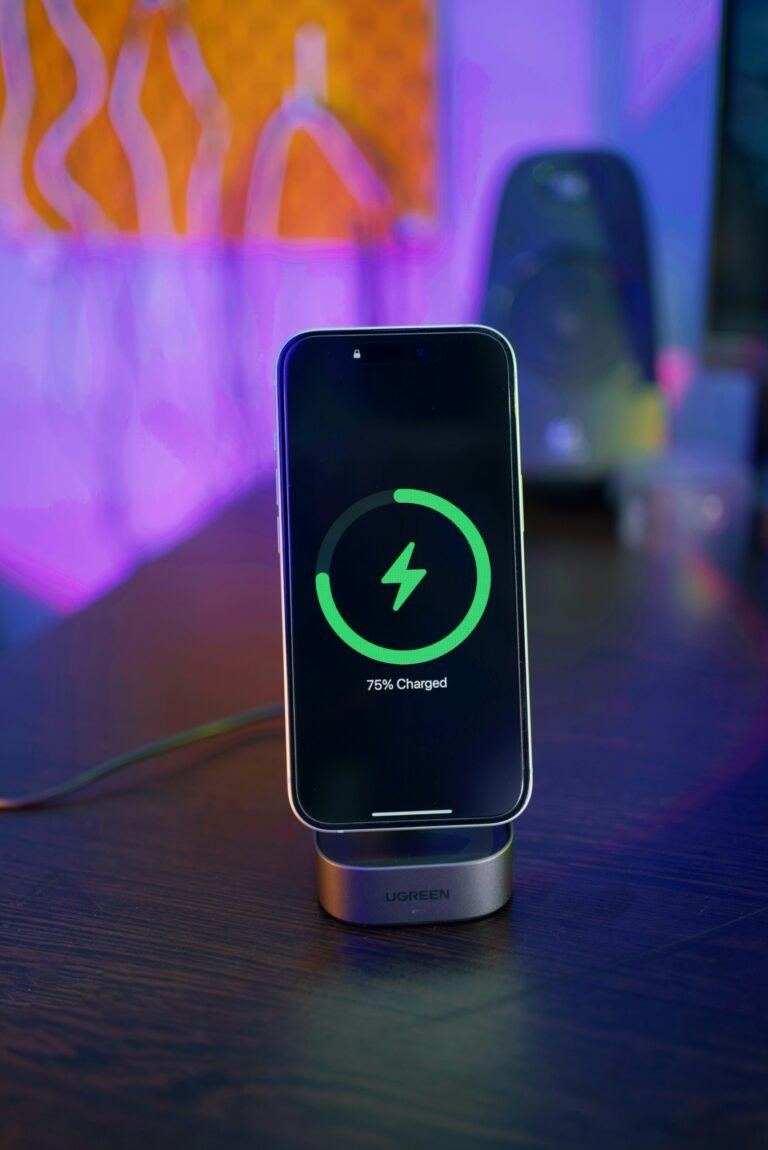
The core trick behind NFC is that it doesn’t need every chip to have its own power source. When an NFC-enabled device — usually a smartphone — gets close to a passive NFC tag, it generates a small electromagnetic field through its antenna. That field induces an electrical current in the tag’s antenna, the same basic principle used in wireless phone chargers, just at a much smaller scale.
That induced current is enough to briefly power the tag’s tiny chip, which then modulates the field to send its stored data back. The reading device picks up that modulation and decodes it as data. No battery, no charging, no bulky electronics — just a coil of wire and a chip, powered entirely by proximity.
This is why an NFC sticker or access card can sit in your wallet for years without ever needing to be charged or replaced. It’s completely passive until something with power — your phone, a payment terminal — brings it to life for a fraction of a second.
Active NFC devices, like smartphones, work a little differently: they generate their own field rather than relying on someone else’s, and they can also read passive tags or talk to other active devices.
The three ways NFC devices communicate
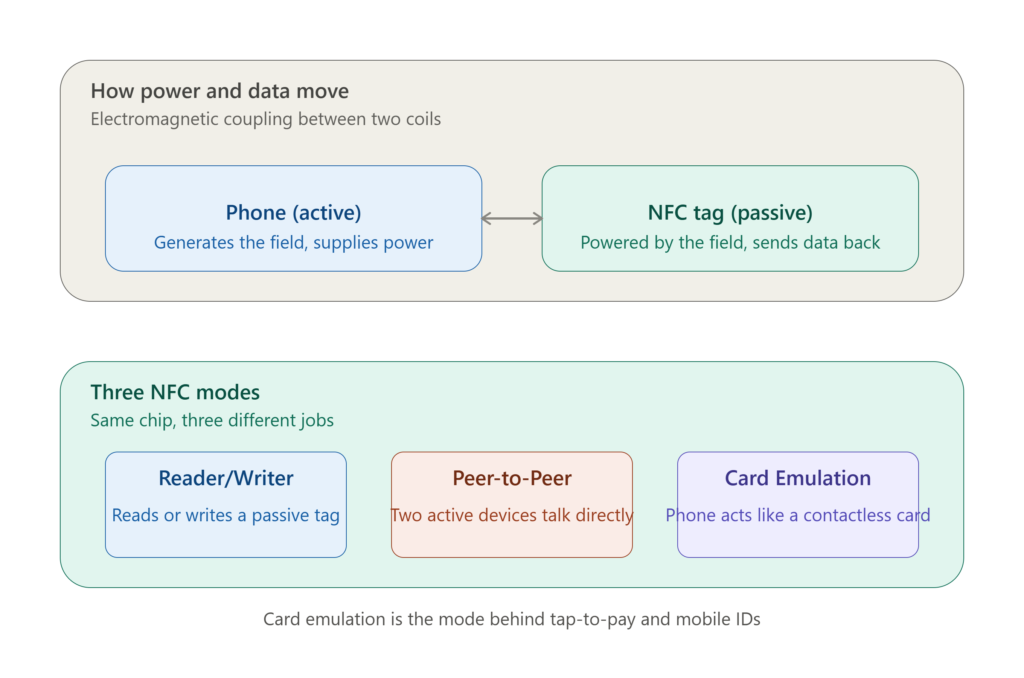
NFC isn’t a single behavior — the standard defines three distinct modes, and the same chip in your phone can typically do all three:
- Reader/writer mode. Your phone acts as the powered device, reading data from (or writing data to) a passive tag — a smart poster, a product sticker, an access card.
- Peer-to-peer mode. Two active, powered NFC devices exchange data directly with each other, without either one acting as a passive tag. This mode exists in the standard but has become less common in everyday use, as most quick-transfer features have shifted to other wireless technologies.
- Card emulation mode. Your phone pretends to be a contactless card rather than reading one. This is the mode behind tap-to-pay, transit cards, and digital badges — the phone presents payment or identity credentials to a reader exactly the way a physical card would.
Card emulation is the mode with the most going on behind the scenes, since it has to protect sensitive data like payment credentials. It typically relies on a Secure Element — a dedicated, isolated chip that stores encrypted credentials separately from the phone’s main processor — or Host Card Emulation (HCE), a software-based approach where credentials are tokenized and managed through the cloud instead of dedicated hardware.
Where you’ll find NFC today
Contactless payments
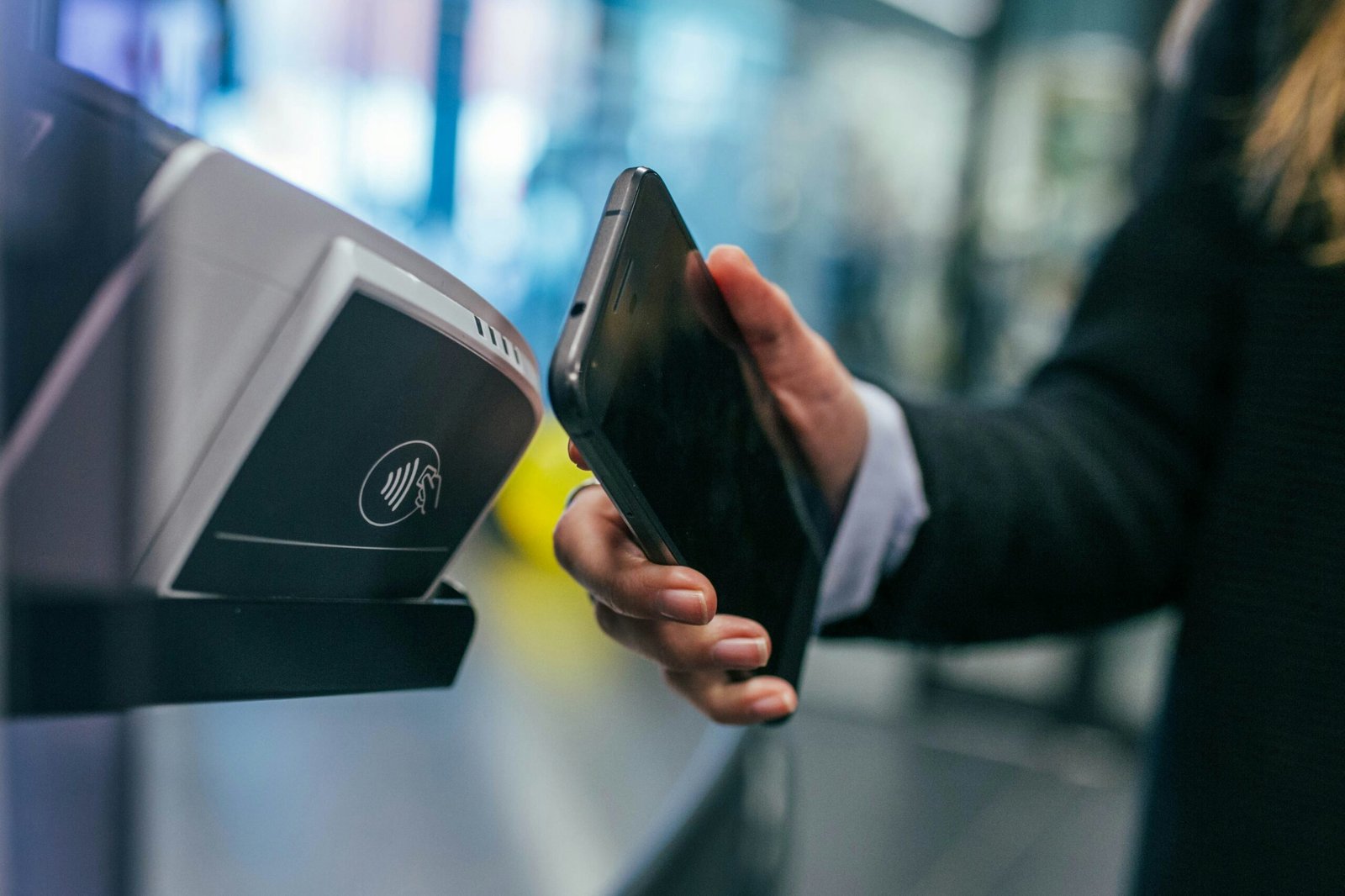
This is NFC’s most familiar job. When you tap your phone or card at checkout, the terminal and your device briefly form a coupled electromagnetic field, and your device transmits a one-time-use payment token rather than your actual card number — a process called tokenization. That’s a meaningful security upgrade over swiping or inserting a card, since even if the transmission were intercepted, the token can’t be reused.
Mobile IDs and driver’s licenses
This is where NFC has expanded the fastest recently. Mobile driver’s licenses store your ID cryptographically on your phone, with a private key that’s generated and locked inside the device’s secure hardware and can’t be copied out. When you tap to show ID, your phone authenticates you with Face ID, Touch ID, or a fingerprint, then transmits only the specific information requested — rather than handing over a photo of your entire physical license.
The rollout has picked up noticeably through 2026: Virginia became the 15th US state to launch Apple Wallet driver’s license support on August 26, 2026, and Apple Wallet IDs are now accepted at TSA checkpoints in more than 250 airports nationwide. North Carolina and other states have mobile ID programs launching later this year. It’s worth noting these digital IDs currently supplement, rather than replace, physical ID — TSA and most retail locations accept them, but police officers conducting a traffic stop generally still require a physical license.
Transit cards, access badges, and smart tags
Public transit systems, office access badges, hotel key cards, and retail smart tags (the kind embedded in a poster or product packaging that pulls up a webpage when tapped) all lean on the same passive-tag behavior described above — cheap, batteryless chips that only need power for the instant they’re read.
Device pairing
NFC is also used as a quick handshake to kick off a more capable wireless connection. Tapping two devices together to start a Bluetooth pairing or a Wi-Fi Direct connection is a common pattern — NFC handles the brief, secure exchange of connection details, then hands off to the faster protocol for the actual data transfer.
NFC vs. RFID vs. Bluetooth: what’s the difference
| NFC | RFID (broader standard) | Bluetooth | |
|---|---|---|---|
| Frequency | Fixed at 13.56 MHz | Varies: LF, HF, or UHF bands | 2.4 GHz |
| Typical range | A few centimeters | Centimeters to several meters, depending on band | Up to ~10 meters or more |
| Communication | Two-way | Often one-way (tag to reader) | Two-way |
| Pairing required | No — instant on contact | No | Yes — discovery and pairing process |
| Best suited for | Payments, IDs, quick taps | Inventory tracking, asset tags at range | Audio, sustained data transfer |
Is NFC secure?
NFC’s very short range is itself a security feature — someone would need to be within a few centimeters of your device to intercept a signal, which rules out the long-range skimming scenarios sometimes shown in fiction. That said, NFC security depends heavily on how it’s implemented:
- Payments are protected by tokenization, meaning your actual card number is never transmitted, plus a biometric or passcode check before most transactions go through.
- Mobile IDs use cryptographic keys stored in secure hardware that can’t be extracted or cloned, rather than a simple data dump like an image of your ID.
- Older or unencrypted passive tags — like some basic access badges — can be more vulnerable if they weren’t designed with encryption in mind, which is why many organizations have moved to encrypted, rewritable NFC credentials over the older generation of simple RFID badges.
The short version: NFC as a transmission technology is quite secure by design, but the actual protection depends on what’s built on top of it.
Why NFC access is opening up in 2026
Until recently, iPhones restricted NFC payment access to Apple Pay and Apple Wallet only. That changed following commitments Apple made to the European Commission under the EU’s Digital Markets Act. As of 2026, third-party wallet and payment providers in the European Economic Area can access iPhone NFC functionality directly through Host Card Emulation, without routing through Apple Pay — banks and fintech companies can now build their own tap-to-pay apps that work independently on iOS. Apple has also extended similar NFC access to developers in several other markets, including the UK, Canada, Australia, Japan, and Brazil.
For everyday users, this mostly means more competition and more wallet app choices at checkout — the underlying NFC hardware in the phone hasn’t changed, just who’s allowed to use it.
Frequently asked questions
Does an NFC chip need a battery? Usually not. Most NFC tags — stickers, cards, badges — are passive and draw their power entirely from the reader’s electromagnetic field. Active NFC devices like smartphones do use their own battery to generate that field in the first place.
How close do two devices need to be for NFC to work? Typically within about 4 centimeters, though the exact range depends on antenna size. This is intentional — NFC’s short range is part of what makes it secure and simple, since accidental or unauthorized reads are much harder at that distance.
Is NFC the same as Bluetooth? No. NFC has a much shorter range but connects instantly with no pairing process, while Bluetooth has a longer range and higher sustained data throughput but requires a discovery and pairing step. They’re often used together — an NFC tap can kick off a Bluetooth connection.
Can someone steal your card information just by walking near you? It’s extremely unlikely with modern contactless cards and phones. NFC’s short range makes casual, distant skimming impractical, and payment transactions use single-use tokens rather than your actual card number, so even a captured signal isn’t reusable.
The bottom line
NFC chips work on a deceptively simple idea: bring two coils close enough together, and the electromagnetic field connecting them can carry both power and data at once. That’s what lets a battery-less sticker respond to your phone, and it’s the same foundation underneath tap-to-pay, mobile IDs, transit cards, and quick device pairing. What’s changed isn’t the underlying physics — it’s how much responsibility that short-range tap is now trusted with, from your credit card to your driver’s license, and how many more apps and companies are being allowed to use it.
Sources: Apple Developer — HCE-based NFC transactions in the EEA, NIST — mobile driver’s licenses.
Also read: How Do AR Glasses Display Images? The Tech Behind Augmented Reality Eyewear