

Table of Contents
Quick answer
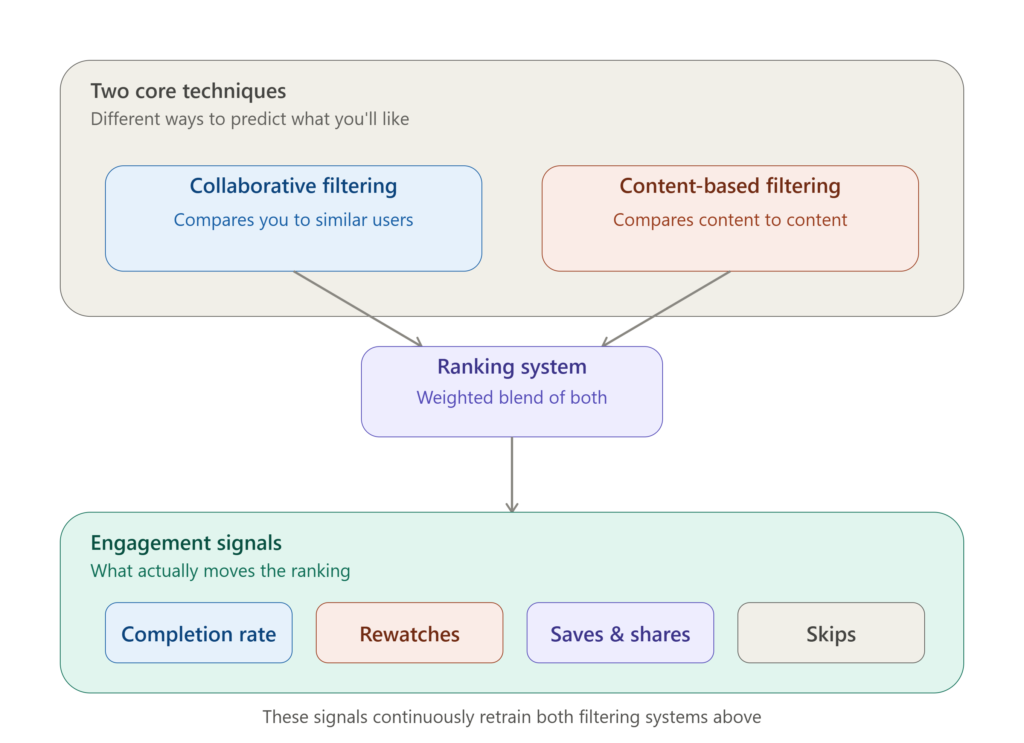
Here’s how recommendation algorithms work, in one sentence: they compare what you do — watch, skip, save, scroll past — against what millions of people with similar behavior did, then predict what you’re statistically most likely to want next. Most platforms blend two techniques to pull this off: collaborative filtering (matching you to similar users) and content-based filtering (matching you to similar content), ranked continuously using real-time engagement signals.
Key takeaways
- Recommendation algorithms mainly rely on two techniques: collaborative filtering (comparing your behavior to similar users) and content-based filtering (matching item attributes to your known preferences).
- Netflix, TikTok, and Spotify each weight these differently, which is part of why the same viewing or listening habit produces a very different kind of feed on each platform.
- None of the major platforms use simple genre or category matching anymore — today’s systems use machine learning models, often including reinforcement learning, that update continuously as you interact.
- Engagement quality is the real currency: completion rate, rewatches, saves, and skips typically matter more than raw views or likes.
- As of 2026, the systems behind these algorithms are actively shifting — TikTok’s US recommendation engine is being independently retrained under new Oracle-led ownership, and Spotify has reportedly grown more conservative, favoring familiar content over aggressive new-artist discovery.
What is a recommendation algorithm?
A recommendation algorithm is a system that predicts what a specific person is likely to want to watch, listen to, or engage with next, based on patterns in their own behavior and the behavior of other users. Instead of showing everyone the same ranked list, these systems generate a personalized version of a feed, homepage, or playlist for each individual — recalculated continuously as new behavior comes in.
That’s different from a basic search or sorting algorithm, which just organizes results that already exist. A recommendation algorithm is trying to predict something that hasn’t happened yet: whether you, specifically, will finish this show, replay this song, or scroll straight past this video.
How recommendation algorithms actually work
Collaborative filtering: “people like you also liked…”
This is the older, foundational technique behind most recommendation systems. Collaborative filtering works by comparing your behavior to other users’ behavior, then recommending items that people with similar taste patterns enjoyed — without the system needing to know anything about the content itself. If enough people who liked the same five shows you did also liked a sixth show, that sixth show gets recommended to you, even if the algorithm has no idea what it’s actually about.
This approach got a major push from the Netflix Prize, a competition Netflix ran starting in 2006 that offered $1 million to anyone who could improve its recommendation accuracy by 10%. The techniques that came out of that competition still influence how collaborative filtering works across the industry today.
Content-based filtering: matching the content itself
The second core approach works in the opposite direction. Instead of comparing you to other people, it compares items to each other based on their actual attributes — genre, cast, tempo, instrumentation, on-screen text, spoken keywords, whatever’s relevant to that type of content. If you’ve been engaging with a certain kind of show or song, the system looks for other items sharing similar characteristics, regardless of what other users did.
The engagement signals that decide what wins
Both techniques feed into a ranking system, but what actually moves an item up or down is a constant stream of real-time engagement data: how long you watched or listened, whether you finished it, whether you rewatched or replayed it, whether you saved, shared, or skipped it. Modern platforms increasingly use reinforcement learning here — a technique where the system keeps adjusting itself based on the outcome of its own past recommendations, rather than relying on one fixed model.
Where you’ll find recommendation algorithms today
Netflix: taste clusters, not genres
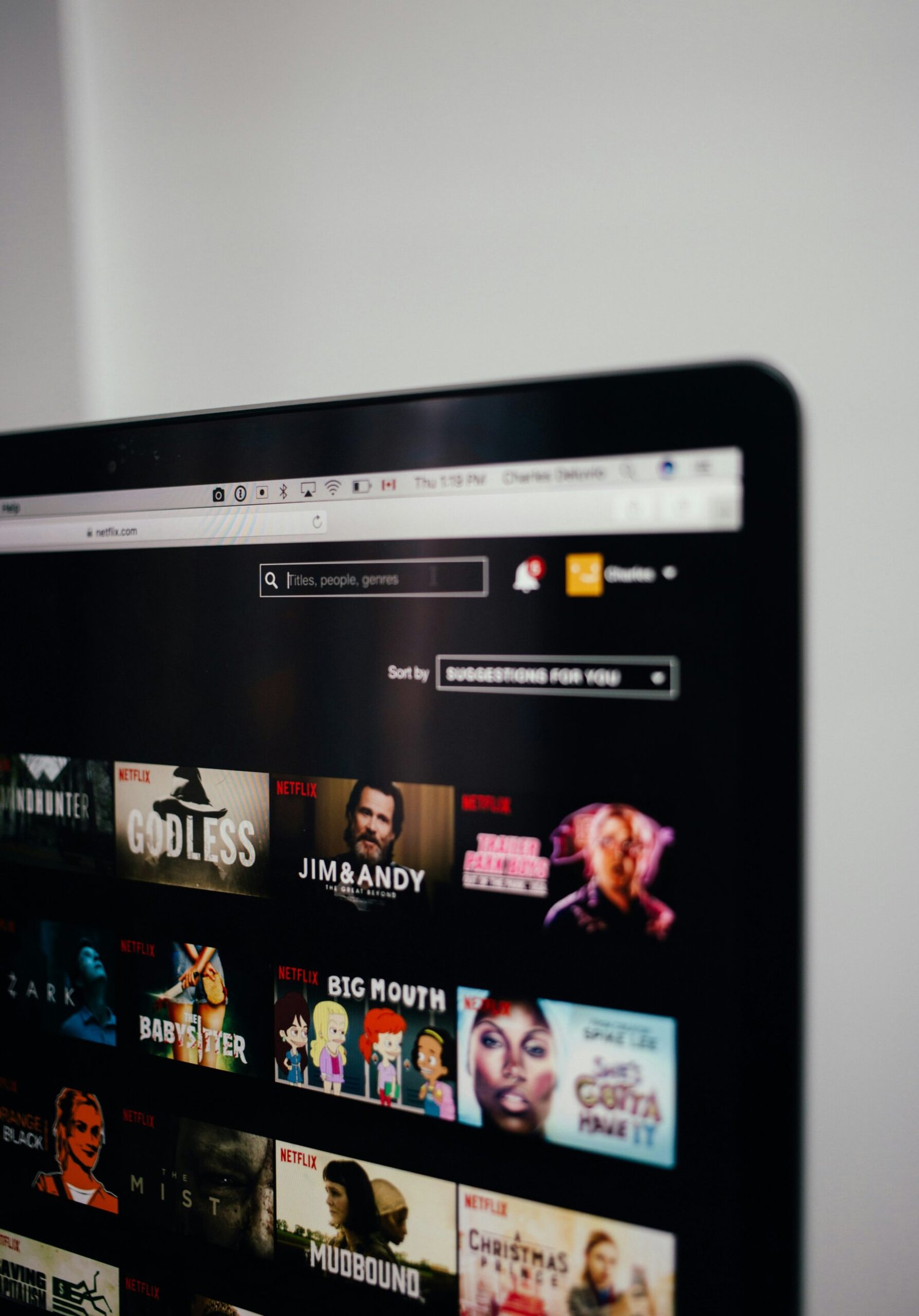
Netflix doesn’t sort users into broad genre categories — it groups viewers into what it calls taste clusters, and recommendations are built around which cluster a given account falls into. According to Netflix’s own help documentation, the system takes feedback from every visit — what you start watching, whether you finish it, and how you rate it — and continually updates its predictions using that data. Notably, Netflix’s recommendation system does not factor in demographic information like age or gender at all.
The result is a homepage that’s structurally different for every account: the rows themselves (“Because You Watched,” “Top Picks for You”), their order, and even the specific titles shown are all personalized. Netflix has said that more than 80% of what people watch on the platform comes from these recommendations rather than active searching.
TikTok: predicting behavior, not tracking followers
TikTok’s For You Page works differently from a typical social feed because it’s built on a behavior graph rather than a social graph — meaning it prioritizes what you watch, rewatch, and engage with over who you actually follow. That’s why a brand-new account with zero followers can rack up millions of views, something that’s much harder on more follower-dependent platforms.
When a video is posted, TikTok initially shows it to a small test audience and tracks completion rate, rewatches, shares, and saves. Strong performance in that first wave expands distribution to a larger group, and so on — meaning a video’s reach isn’t decided the instant it’s posted, but shaped by how real viewers respond to it over the following hours.
Spotify: three systems working together
Spotify blends three distinct data sources to power its recommendations: collaborative filtering based on listener behavior, natural language processing that scans text associated with a track (artist bios, playlist titles, “fans also like” connections), and direct audio analysis of the song’s actual sonic characteristics.
This powers several different personalized surfaces: Discover Weekly, which refreshes every Monday with tracks you haven’t heard before; Release Radar, which surfaces new music from artists you already follow; and Daily Mix and Radio, which blend familiar favorites with occasional new picks. Artists and labels can also opt individual tracks into Discovery Mode, a Spotify-run program that adds an artist-priority signal into the recommendation system — in exchange for a reduced royalty rate on the extra streams it generates.
Instagram, YouTube, and the rest
Despite the branding differences, most major platforms — Instagram’s Explore and Reels, YouTube’s homepage and Up Next queue, and others — run on the same handful of underlying techniques described above: some blend of collaborative filtering, content-based filtering, and continuously updated engagement signals. What changes from platform to platform is mostly which signals get the most weight, and how aggressively the system favors new discovery versus familiar content.
Recommendation algorithms vs. traditional sorting: what’s different
| Traditional sorting | Recommendation algorithm | |
|---|---|---|
| Basis | Chronological order or a fixed rule (most recent, most popular) | Predicted individual relevance |
| Personalization | Same result for every user | Unique per user, continuously updated |
| Signals used | View counts, like counts | Completion rate, rewatches, saves, skips, session context |
| Adapts over time | No | Yes, in near real time as you interact |
Why algorithms sometimes get it wrong
Recommendation systems aren’t perfect, and understanding their limits is part of understanding how they work:
- The cold start problem. A brand-new user or a brand-new piece of content has no behavioral history yet, so the system has very little to base a prediction on until some data accumulates.
- Feedback loops. Because these systems learn from what you already engage with, they can gradually narrow what you’re shown toward things that resemble your past behavior, rather than actively introducing you to something different — sometimes called a filter bubble effect.
- Limited transparency. Platforms rarely explain exactly why a specific recommendation appeared, which is part of why recommendation systems are sometimes described as a “black box,” even by people who study them closely.
None of this means the systems are broken — it’s more that predicting what a person wants next is inherently uncertain, and these are the trade-offs that come with it.
Why the algorithms behind them are shifting in 2026
TikTok’s recommendation system is currently in the middle of a significant structural change. On January 22, 2026, a new U.S. joint venture officially took over operational control of TikTok’s American business, with Oracle, Silver Lake, and Abu Dhabi’s MGX each holding a 15% stake, other U.S. investors holding roughly 35%, and ByteDance retaining a minority stake of about 19.9%. As part of that deal, Oracle is overseeing an independent retraining of TikTok’s U.S. recommendation algorithm using only U.S. user data, with ByteDance barred from accessing that data or influencing how the American version of the algorithm works.
Spotify’s system has been shifting too, though more gradually — several people who track the platform closely have noted that its recommendations have grown more conservative over the past year or so, leaning toward familiar, previously-heard music rather than aggressively surfacing new artists the way Discover Weekly was originally known for.
The underlying lesson for anyone using these platforms: a recommendation algorithm isn’t a fixed, unchanging thing. It’s a system that’s actively maintained, retrained, and adjusted — sometimes for technical reasons, and sometimes, as with TikTok, for regulatory ones.
Frequently asked questions
Does watching or listening to something once change my recommendations? Usually yes, to some degree — these systems update continuously, so a single strong engagement signal (finishing a show, saving a song) can nudge future recommendations, though it typically takes a pattern of behavior to meaningfully shift what you’re shown.
Can I turn off personalized recommendations? On most platforms, you can limit personalization to some extent through privacy or account settings, though very few offer a way to fully disable it, since personalized ranking is usually built into how the core feed or homepage functions.
Is the same content shown to every user, or is it different for each person? It’s different for each person. Even two accounts that follow the exact same people or watch the exact same shows will typically see recommendations in a different order, since the ranking is calculated per account.
Do recommendation algorithms track what I do outside the app? It depends entirely on the platform and its specific privacy policy — some incorporate data from other services they own, while others rely primarily on in-app behavior. Checking that platform’s own privacy documentation is the only reliable way to know what’s actually factored in.
The bottom line
Recommendation algorithms all come back to the same basic engine: compare your behavior to other people’s, compare content to other content, and keep adjusting the mix based on what actually keeps you watching, listening, or scrolling. Netflix, TikTok, and Spotify each tune that engine differently — which is exactly why the same person’s habits produce three very different-feeling feeds — but underneath the branding, it’s collaborative filtering, content-based filtering, and a constant stream of engagement data doing the work. And as 2026 is showing with TikTok’s ownership change, even the algorithms themselves aren’t static — they’re systems that get rebuilt, retrained, and renegotiated over time.
Sources: Netflix Help Center — How Netflix’s recommendations system works, Spotify for Artists — Discovery Mode, Variety — TikTok U.S. joint venture deal.
Also read: How to Go Viral on Social Media: How the Algorithm Helps